Last updated: July 2026
If you’ve ever sent Facebook or Pinterest traffic straight to an affiliate link and watched exactly nothing happen, you already know why “affiliate marketing sales funnel examples” gets searched thousands of times a month.
Direct linking is close to dead for cold traffic. People don’t buy on the first click, and the affiliates actually making money aren’t sending clicks to someone else’s sales page and hoping. They’re building funnels.
I run ClickBank affiliate funnels in US, mostly in the make-money-online and marketing tools space. Some convert well. Some flopped hard. The difference was almost never the traffic source or the offer. It was the structure between the two.
This post is a working affiliate’s notebook. Six real funnel structures that convert, when each one fits, the tools you actually need, and the honest reason most affiliates skip the funnel and stay broke. If you want a specific case study, I’ll walk you through the exact webinar funnel I use for John Thornhill’s Ambassador Program in Example 2.
Disclosure: Some links in this post are affiliate links. If you buy through them I earn a commission at no extra cost to you. I only recommend tools and offers I’ve used or currently run in my own funnels.
What Is a Sales Funnel in Affiliate Marketing?
An affiliate marketing sales funnel is a sequence of pages and emails that turns cold traffic into a warm buyer before you ever send them to the affiliate offer. Instead of one link doing all the work, the funnel splits the job across a lead capture page, an email sequence, and a bridge or sales asset that pre-sells the product.
Think of it as a filter. Traffic goes in at the top. Subscribers, then buyers, come out the bottom. Every stage removes people who were never going to convert and warms up the ones who might.
The affiliate link isn’t the funnel. It’s the last step in a funnel someone else already ran to warm the buyer up.
Why Most Affiliates Skip the Funnel and Lose Money
Building a funnel takes work. Writing a Medium article and dropping an affiliate link takes twenty minutes. So most beginners do the second thing, get zero sales, and quit.
That’s the real reason 95% of affiliate marketers make less than $1,000 a year. Not the niche. Not the algorithm. They never built the middle piece that converts a stranger into a subscriber.
Direct Linking vs Funnel Conversion Rates
Cold direct linking to an affiliate offer typically converts between 1% and 2% at absolute best, and often much less. A properly built funnel with an email sequence in front of it can push the same traffic to 15-30% conversion into a subscriber, with 3-8% of those subscribers going on to buy the front-end offer over the following weeks. That’s not theory. It’s the same math the ClickBank affiliate blog reports, and it lines up with what I see across my own funnels.
The economics aren’t close. If you’re paying for traffic, direct linking guarantees you lose money. A funnel is what lets you actually break even and then profit off the email list.
The Trust Gap Between Cold Traffic and an Affiliate Offer
There’s a psychological gap between “person clicked a Facebook ad” and “person is ready to hand a stranger their credit card.” Nobody buys from a link they don’t trust in a headline they’ve never seen from a person they’ve never heard of. The funnel closes that gap in stages: give them a reason to opt in, deliver something useful, tell them a story, then make the offer.
Skip the middle and you’re asking cold traffic to buy from cold copy. It never works.
The 4 Stages of Every Affiliate Marketing Funnel (AIDA + Value Ladder)
Every funnel that works maps roughly to the AIDA framework: Attention, Interest, Desire, Action. Marketers also talk about TOFU, MOFU, and BOFU (top, middle, and bottom of funnel), which is the same idea with different labels. Here’s how the stages actually work in an affiliate context.
Awareness (TOFU)
This is where you catch attention. Blog post, YouTube video, TikTok, Pinterest pin, ad. The reader has a problem, isn’t sure what to do about it, and doesn’t know you exist yet. Your job here is not to sell. It’s to be useful enough that they click the next thing.
Interest (MOFU)
They opted in for something. Usually a lead magnet, a free video, or a webinar registration. Now you have their email address and one honest job: make them care about the topic before making the offer. This is where the autoresponder sequence lives. Most affiliates either skip this step or write three generic emails and give up.
Decision (MOFU/BOFU)
They’re actively comparing. Reading your review, watching your webinar replay, checking whether the offer is legit. Your bridge page, sales video, or review sits here. This is where the pre-sell happens, meaning you connect their pain to the specific product without pitching it too early.
Action (BOFU)
They click through to the affiliate sales page and buy. This part isn’t yours anymore. It’s the vendor’s sales page doing the closing. Your only job at this stage is to have picked an offer with a sales page that actually converts, which is not something to assume.
6 Affiliate Marketing Sales Funnel Examples
Here are the six structures that consistently produce results for affiliates. Each one fits a different offer type, traffic source, and skill level.
Example 1: The Lead Magnet Funnel
Structure: Free PDF, checklist, or template → opt-in page → thank-you page with soft affiliate offer → 5-to-7-email autoresponder sequence with the real pitch.
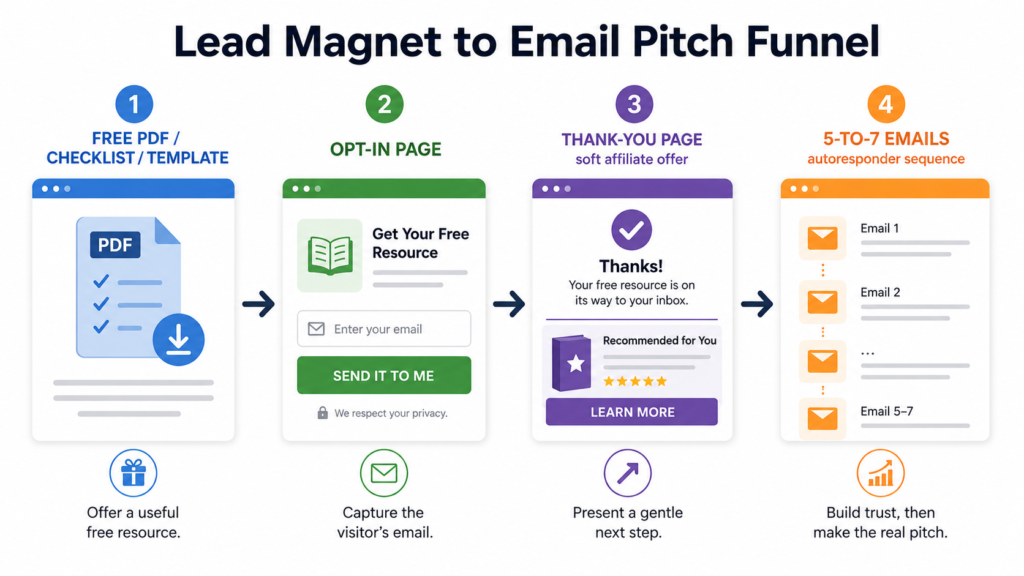
This is the entry-level funnel and the one I’d tell any beginner to build first. The lead magnet (an “opt-in bribe” in old-school direct response terms) has to solve one specific problem in one afternoon of reading. Not a 60-page ebook. A one-page checklist that gets used.
Best for: Front-end offers in the $27-$97 range. Info products, courses, software trials.
Real conversion range: 25-40% opt-in on warm traffic, 10-20% on cold. Front-end sale conversion from the email sequence usually lands between 2% and 6% of subscribers.
Tools: An email autoresponder (GetResponse, ConvertKit, ActiveCampaign), a page builder or a WordPress landing page (I use Astra with a custom template), and the affiliate link.
Small detail beginners miss: the thank-you page is not a thank-you page. It’s a soft sales page. That’s where your best conversions come from, not the emails.
Example 2: The Webinar Funnel
Structure: Ad or blog post → webinar registration page → confirmation page → live or evergreen webinar → replay page → email follow-up sequence → high-ticket affiliate offer at the end.
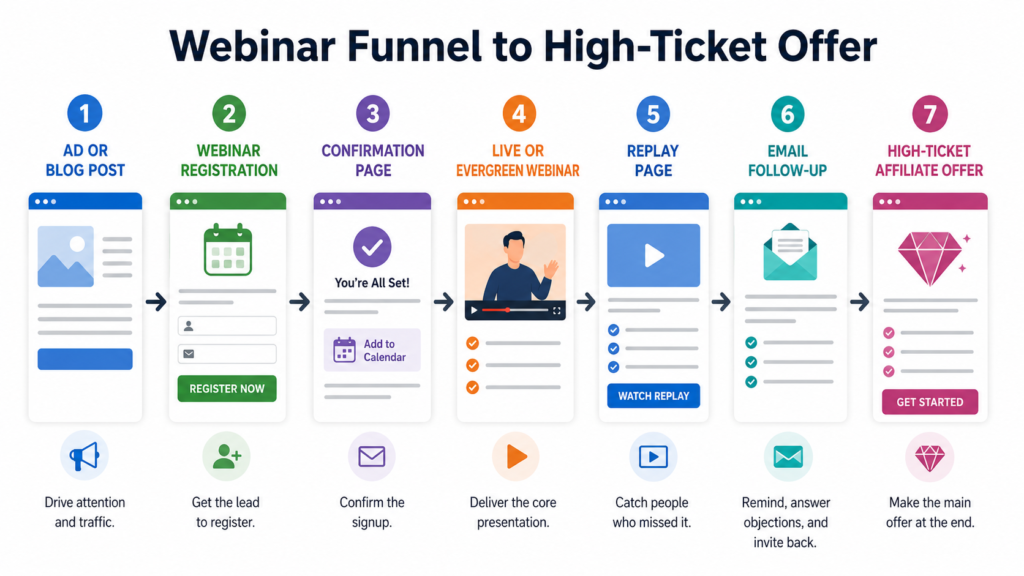
This is the funnel I run for John Thornhill’s Ambassador Program, and it’s the one that pays my bills. Webinar funnels sell high-ticket ($497-$2,997) affiliate offers that no other funnel type can move. The reason is time. A 60-90 minute webinar builds enough trust, gives enough value, and demonstrates enough proof to justify a real price tag.
Cold traffic normally won’t buy a $997 course from an email. It will buy it after an hour of watching someone teach for free. That’s the entire mechanic.
Best for: High-ticket affiliate offers, $297 and up. Coaching, done-for-you services, high-end courses.
Real conversion range: Registration to attendance 25-45% (evergreen usually higher than live). Attendance to sale 2-6% on cold traffic, 5-15% on a warm list.
Tools: Webinar platform (WebinarJam, EverWebinar, or the Ambassador Program’s done-for-you setup), autoresponder, retargeting pixel.
The Ambassador Program is the case I know best. Thornhill runs the webinar. His team wrote the emails. You send traffic and get paid on the high-ticket back-end offers ($997 to $10,000+ range) that his sales team closes. It’s the closest thing to a done-for-you high-ticket funnel that exists on ClickBank.
See the exact webinar funnel I use for the Ambassador Program →
If you plan to run live webinars for a US audience, you’ll be presenting at 2am your time. Evergreen solves that. Every serious high-ticket affiliate I know runs evergreen with real-time chat replays.
Example 3: The Bridge Page Funnel (Miles Beckler model)
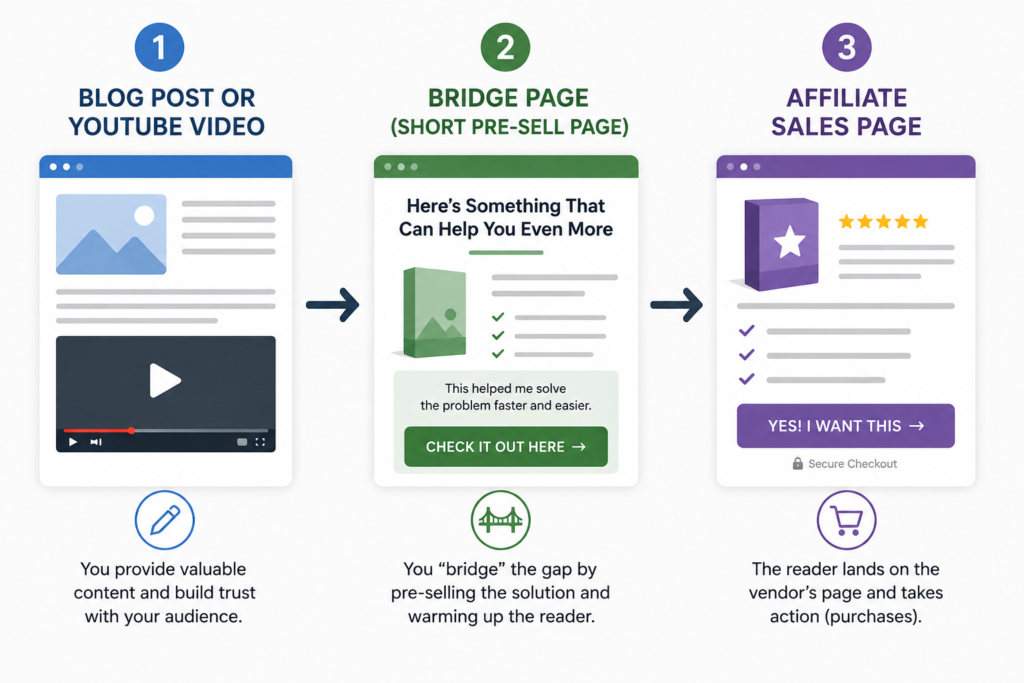
Structure: Blog post or YouTube video → bridge page (a short pre-sell page that “bridges” the reader to the vendor’s offer) → affiliate sales page.
Miles Beckler popularized this one for a reason. It’s the simplest way to add a pre-sell layer to an affiliate offer without building a full email funnel. The bridge page does three things: acknowledges what the reader wanted, sets expectations for what they’re about to see on the vendor’s page, and handles the objection that they’re being sold to.
Best for: Mid-ticket offers ($97-$497). Especially useful when the vendor’s sales page is long, aggressive, or off-brand from your audience.
Real conversion range: Bridge page click-through 40-70%. Final sale rate whatever the vendor’s page normally converts at, usually 1-4%.
Tools: One landing page. That’s it. You can build one in Elementor or with a simple WordPress template in an afternoon.
The catch: you don’t collect emails here, which means one shot at the sale. Bridge pages work best layered on top of a lead magnet funnel, not as the whole strategy.
Example 4: The Tripwire Funnel
Structure: Traffic → landing page → low-cost offer ($7-$27) → order bump → upsell → downsell → affiliate offer on the thank-you page.
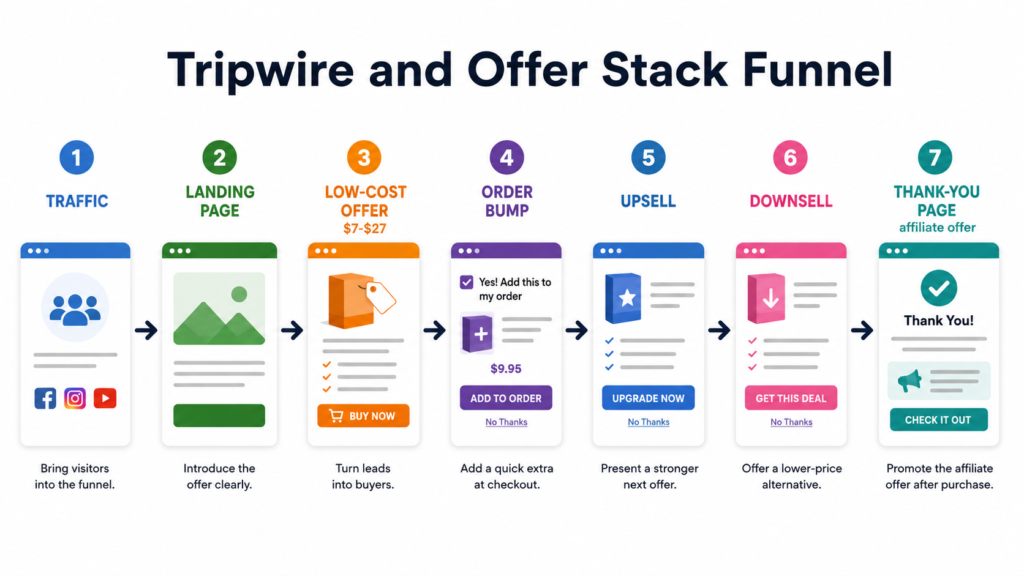
The tripwire funnel is a paid ads specialist’s tool. The tiny front-end offer isn’t there to make money. It’s there to convert a browser into a buyer, because a buyer will buy again at roughly 10x the rate of a non-buyer. Once someone hands over a credit card, everything downstream converts better, including your affiliate promotions.
Best for: Paid traffic. Recurring affiliate offers on the back-end. Not recommended for beginners, because the front-end product usually has to be yours.
Real conversion range: Tripwire conversion 3-8% of landing page visitors. Upsell take-rate 15-30%. Back-end affiliate offer conversion much higher than cold because the audience is now a paying customer.
Tools: Full checkout stack (ThriveCart, SamCart, or ClickFunnels). This is the most technical funnel on the list.
Honest opinion: if you’re new, don’t start here. This funnel makes sense once you have a product of your own and are running paid ads, not before.
Example 5: The Product Review Funnel
Structure: SEO blog post reviewing a specific product → in-post opt-in for a comparison guide or bonus stack → autoresponder → affiliate link.
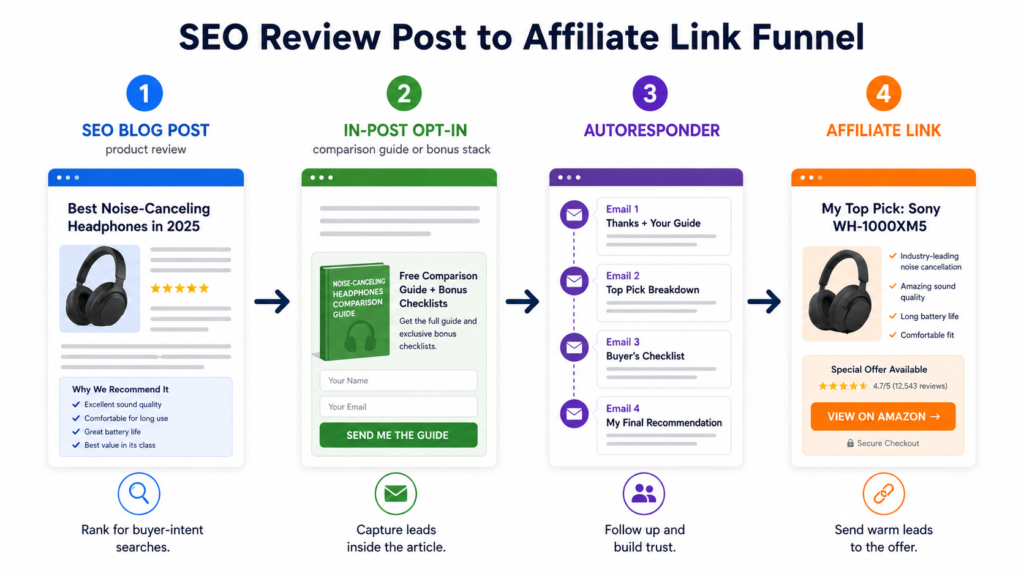
This is the workhorse of SEO-driven affiliate marketing. Someone searches “[product name] review” or “[product] vs [competitor],” lands on your honest review, opts in for a bonus PDF or comparison chart, and gets emailed into the affiliate offer over the following weeks.
Best for: Any price point where buyers actively research before buying. Software, courses, physical products.
Real conversion range: Organic buyer-intent traffic is the highest-converting traffic that exists on the internet. Expect 10-25% opt-in rates on review posts and 5-15% conversion from opt-in to sale on genuinely useful reviews.
Tools: WordPress, a review schema plugin (I use Rank Math PRO for schema), an autoresponder, and a bonus asset.
The trick is the “vs” post and the “alternatives” post, both of which pull buyer-intent traffic that a plain review misses. Beginners forget those exist and leave money on the table.
Example 6: The Value Ladder Funnel (Russell Brunson model)
Structure: Free lead magnet → low-ticket offer ($7-$47) → mid-ticket offer ($97-$497) → high-ticket offer ($997+) → recurring/continuity.
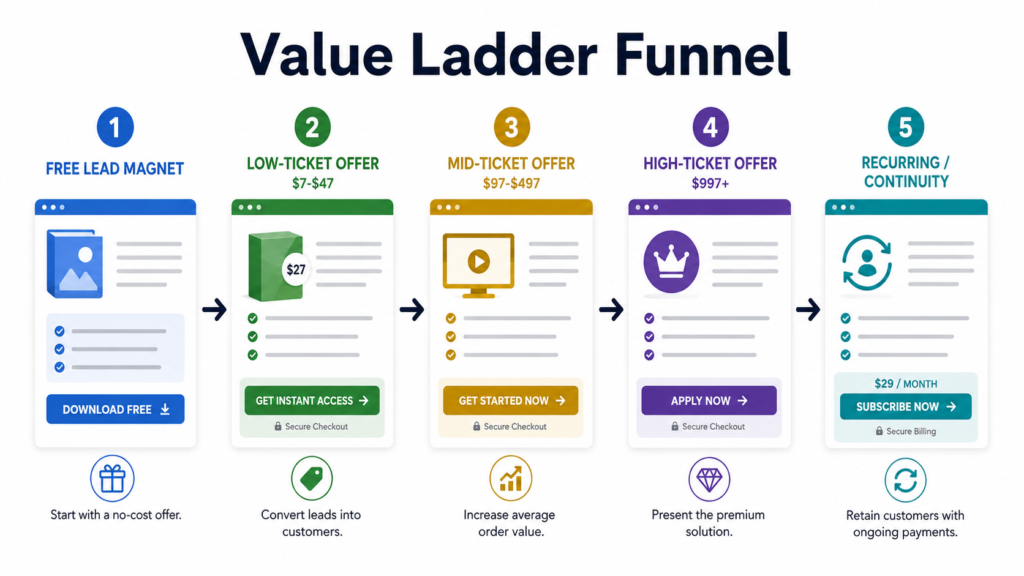
Russell Brunson popularized the value ladder in DotCom Secrets, and it’s the framework serious affiliates build their businesses around. Instead of one funnel selling one thing, you build a ladder of offers where each rung pre-qualifies the buyer for the next.
Best for: Full affiliate businesses, not single campaigns. Multi-vendor stacks where the front-end, middle, and back-end are different products but sit in the same buyer journey.
Real conversion range: Depends entirely on how well you match the rungs. Done right, the compounding conversion rates outperform every other model.
Tools: Everything above combined. This is the endgame, not the starting point.
Most affiliates never build one because they’re too focused on the next front-end offer. The ones who do build the ladder are the ones with real income.
How to Choose the Right Funnel for Your Affiliate Offer
Not every funnel fits every offer. Picking the wrong one is the single biggest reason a launch flops.
Match Funnel to Product Price Point
Cold traffic won’t buy a $997 course from a bridge page and email sequence, no matter how good either one is. Cold traffic also won’t sit through a 90-minute webinar for a $27 ebook. Price sets the funnel.
- $0-$47: Bridge page or product review funnel
- $47-$297: Lead magnet funnel with autoresponder
- $297-$997: Webinar funnel
- $997+: Webinar plus application call, or full value ladder
Match Funnel to Traffic Source
SEO traffic is warm and buyer-intent. It thrives in product review funnels and lead magnet funnels. Paid Facebook traffic is cold and interruption-based. It needs webinars, tripwires, or heavily pre-sold bridge pages to convert.
Pinterest and TikTok sit somewhere between. Warm curiosity, low buying intent. Lead magnet funnels tend to work best there.
Match Funnel to Your Skill Level
Beginners should build the lead magnet funnel first. It teaches every skill you’ll need for every other funnel, and it does it at a scale small enough that mistakes don’t cost much. Intermediate affiliates move to webinar or bridge page funnels once they know their audience. Tripwires and full value ladders come last.
I built lead magnet funnels for two years before I attempted a webinar funnel. That was the right order.
How to Build Your First Affiliate Sales Funnel (5 Steps)
If you’ve never built a funnel, here’s the shortest path from zero to first sale that I’d recommend to someone starting today.
Step 1: Pick a Product With Proven Conversion Data
Not the product with the biggest commission. The product with the highest gravity, best refund rate, and a sales page you’d actually buy from. On ClickBank, gravity above 30 with a refund rate under 10% is a safe starting range. The vendor’s sales page is going to do the closing. If it’s ugly, sleazy, or slow, walk away.
Step 2: Build the Lead Capture Page
One headline that names the reader’s problem. One bullet list of what they get. One button. That’s it. Don’t overdesign. My highest-converting opt-in pages have been the ugliest ones because they load fast and don’t distract.
Tools: WordPress with Astra and a page builder, or a hosted tool like Systeme.io if you don’t want to touch WordPress.
Step 3: Write the Email Sequence
Seven emails minimum. Email 1 delivers the lead magnet. Emails 2-4 build trust with story and useful content. Emails 5-7 make the offer with increasing urgency. This is not a place to be clever. This is a place to be specific about the reader’s problem and honest about why the offer solves it.
If writing seven emails from scratch sounds hard, this is the exact stage where done-for-you affiliate programs pay off. Ambassador Program affiliates get the vendor’s proven email sequence included, which removes the biggest failure point for beginners.
Step 4: Drive Targeted Traffic
Pick one source. Master it before adding a second. SEO is slow but compounds. Paid ads are fast but expensive. Pinterest is free and steady. YouTube is the highest ROI long-term for most affiliates I know, but takes 6-12 months to warm up.
Don’t chase every channel at once. One source, one funnel, six months.
Step 5: Track, Test, Iterate
You need to know four numbers: traffic to opt-in rate, opt-in to open rate, open to click rate, and click to sale rate. That’s the funnel. Fix the worst-performing number first. Almost always it’s the opt-in page headline or the email subject lines.
I’ve seen a single subject-line rewrite move a sequence from 12% opens to 34% opens. Don’t skip this step.
Affiliate Funnel Comparison Table
| Funnel Type | Best For | Price Point | Difficulty | Setup Cost | Typical Conversion |
|---|---|---|---|---|---|
| Lead Magnet Funnel | Front-end info products, list building | $27-$97 | Beginner | $30-$100/mo | 2-6% opt-in to sale |
| Webinar Funnel | High-ticket offers, coaching, courses | $497-$2,997 | Advanced | $100-$300/mo | 2-6% cold, 5-15% warm |
| Bridge Page Funnel | Mid-ticket, mismatched vendor pages | $97-$497 | Beginner | Under $30/mo | 1-4% final sale |
| Tripwire Funnel | Paid traffic, back-end affiliate stacks | $7 front / high back-end | Advanced | $100-$300/mo | 3-8% tripwire, 15-30% upsell |
| Product Review Funnel | SEO-driven, buyer-intent traffic | Any | Intermediate | $50-$150/mo | 5-15% subscriber to sale |
| Value Ladder Funnel | Full affiliate business, multiple offers | Full range | Expert | $200+/mo | Compounding |
Frequently Asked Questions
What is the best sales funnel for affiliate marketing?
There isn’t one best funnel. There’s a best funnel for your specific price point, traffic source, and skill level. For most beginners promoting a $47-$197 front-end offer with SEO or organic social traffic, the lead magnet funnel is the fastest path to a first sale. For high-ticket affiliates ($497 and up), the webinar funnel outperforms everything else.
How much does it cost to build an affiliate marketing funnel?
A minimum viable funnel runs $30-$100 per month in tool costs. That covers an autoresponder ($15-$45/mo), a page builder or WordPress setup ($0-$30/mo), and a domain ($15/year). If you use an all-in-one tool like Systeme.io, the free tier can run a basic funnel at $0 to start. Paid traffic on top of that is a separate budget entirely.
How long does it take to see results from an affiliate funnel?
If you’re paying for traffic, you can see your first sale within a week of launching. If you’re relying on SEO, expect 6-12 months before the funnel produces consistent commissions. YouTube sits in the middle, usually 3-6 months. The funnel itself takes 2-5 days to build. Building the audience that feeds it takes longer.
Can you do affiliate marketing without a funnel?
You can, but the math is bad. Direct linking converts at roughly one-tenth the rate of a funnel, and you lose the email list, which is where the actual profit lives. Even a bare-minimum bridge page beats direct linking. If you’re serious about affiliate income, you need some form of funnel. It doesn’t have to be complicated.
What tools do I need to build an affiliate funnel?
At minimum: an autoresponder (ConvertKit, GetResponse, ActiveCampaign, or the free tier of Systeme.io), a landing page (a WordPress page with Astra works fine, or a dedicated page builder), and a lead magnet. That’s it. Everything else is optional. The tools everyone recommends when you start out are almost always overkill for your first funnel.
Bringing It Together
Six funnel types, one pattern underneath them: warm cold traffic in stages before making the offer. Pick the one that fits your price point, your traffic source, and your current skill level. Build it end-to-end. Send traffic. Fix the weakest number first.
If you’re going after high-ticket affiliate commissions and don’t want to write the emails, build the webinar, and figure out the pre-sell yourself, the John Thornhill Ambassador Program is the closest thing to a done-for-you version of the Example 2 funnel above. It’s what I run.
Want the done-for-you version of this funnel? See the Ambassador Program →
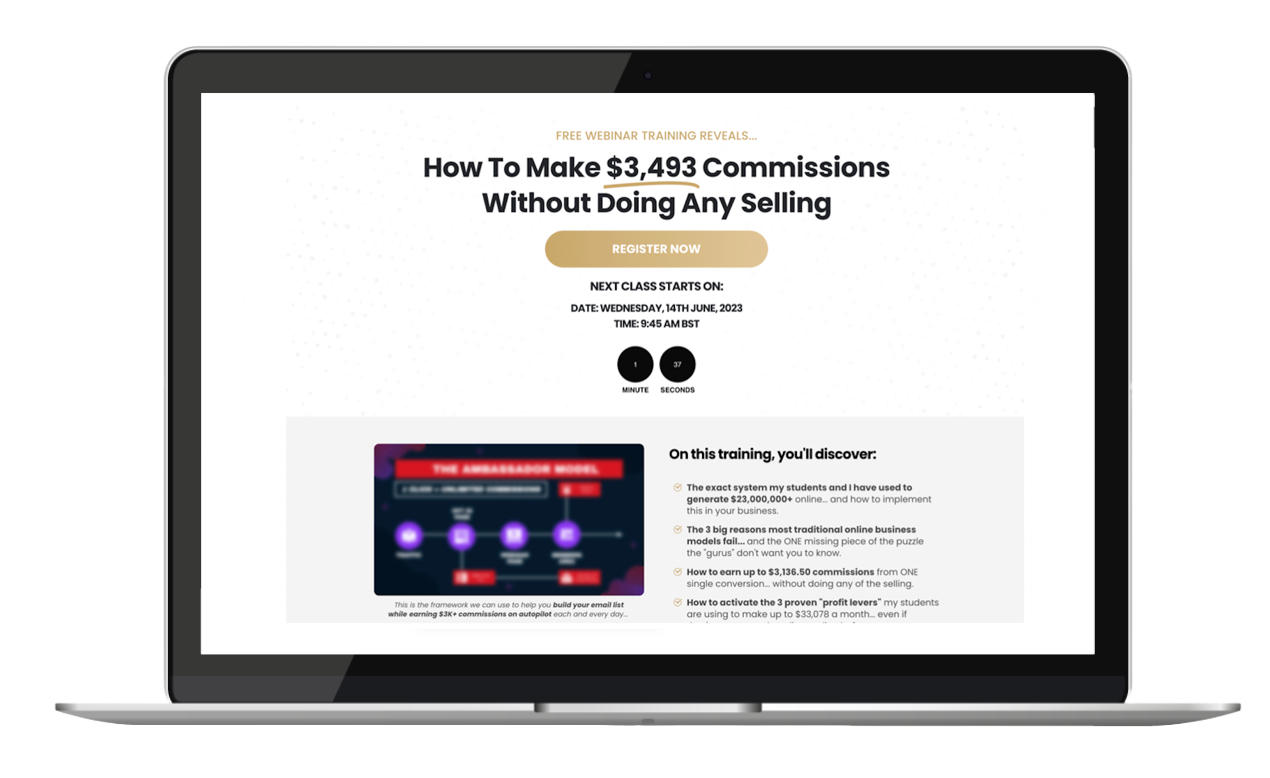
More details on John Thornhill – The Ambassador Program →
About the author
Joseph is an affiliate marketer and developer based in US, running a portfolio of WordPress affiliate sites in the make-money-online, marketing tools, and home product niches. He builds and tests ClickBank funnels for a living and writes about what actually works, not what’s supposed to work. Site stack: WordPress, Astra, Rank Math PRO, and a lot of coffee.